
Container pools in Texas
Why choose a shipping
container pool?
A factory-built, marine-grade steel shell installed on your property in weeks — not a six-month construction project in your backyard.
Most of our clients aren't first-time pool buyers — they've gotten a gunite quote, seen the timeline, and started looking for a faster, less destructive way to get a real swimming pool in the backyard. A shipping container pool — built off-site as a finished steel shell and craned into place — delivers exactly that.
The real difference is speed and mess. No months of forms, rebar, and shotcrete tearing up your yard, no guessing when the crew will show up next. The container shell arrives largely finished, gets set on a prepped pad or piers, and gets plumbed in. For Texas homeowners on tight urban lots, sloped sites, or anyone who just wants a pool this season instead of next year, this is the alternative.
- Installed in weeks, not months — most container pools go from delivery to first swim in two to four weeks.
- Factory-built marine-grade steel shell, engineered and pressure-tested before it ever reaches your yard.
- Fits tight, urban, and hard-to-access lots where a full excavation pool would never work.
- Handles sloped sites easily — the container sits on piers or a simple pad instead of a massive dug basin.
- Set above-ground, partially recessed, or fully in-ground depending on your yard and budget.
- Optional glass viewing window turns the shell into a feature, above and below the waterline.
- Swim jets, heaters, LED lighting, and saltwater or chlorine sanitizing — every option a conventional pool has.
- A movable asset: if you ever relocate, your container pool can go with you.
- Dramatically less yard destruction than gunite — no months of mud, forms, or heavy equipment tearing up the lot.
- Costs well under a comparable gunite pool, with a fraction of the construction timeline.
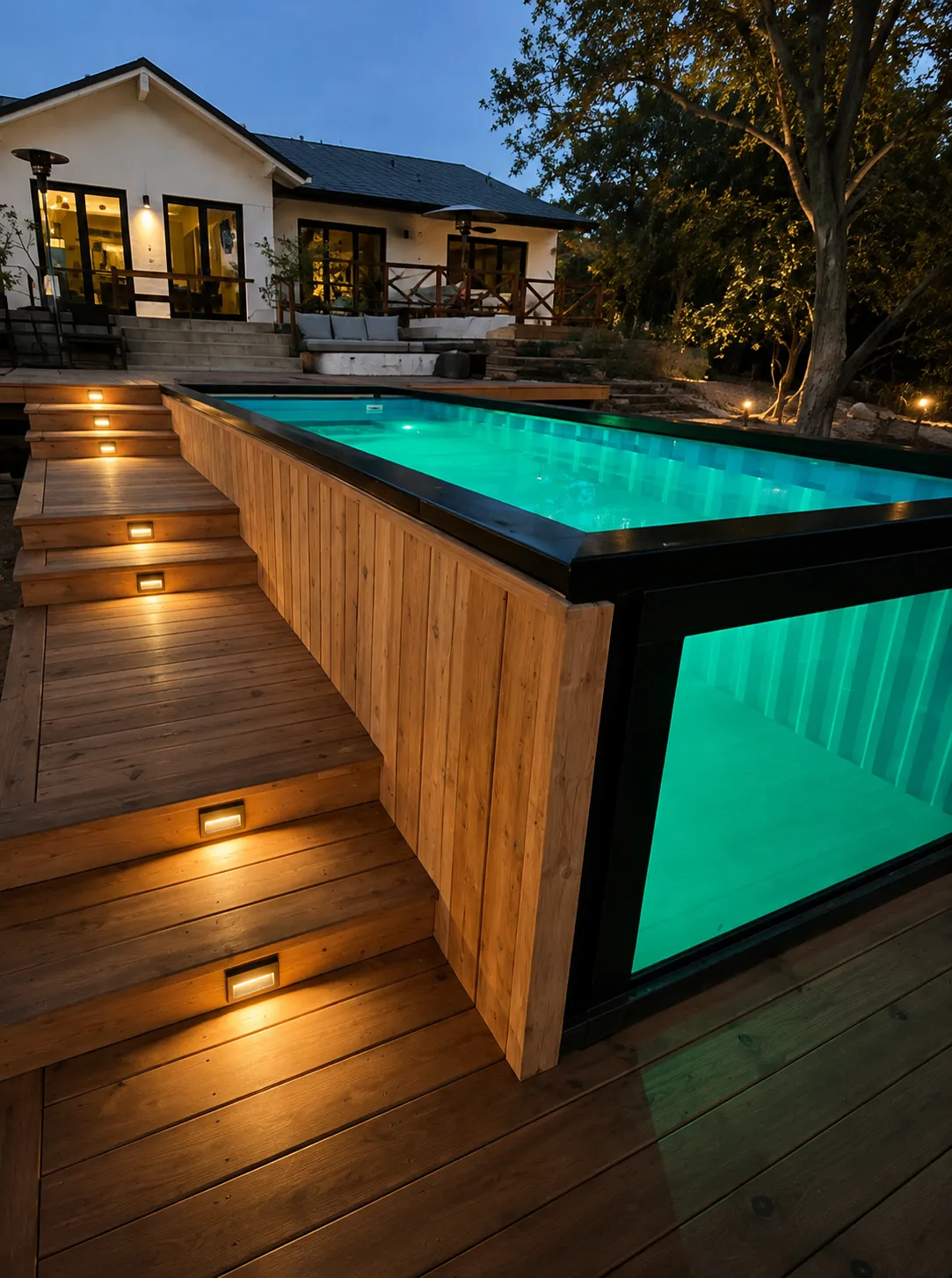
How a container pool is actually built
A container pool starts life as a heavy-gauge steel shipping container that we structurally reinforce, cut, insulate, and coat for permanent water contact. Plumbing, skimmers, return jets, lighting, and — if you want one — a glass viewing panel are all built into the shell before it ever leaves the fabrication yard. What arrives at your house is a finished pool, not a raw container.
On site, the shell is set by crane onto a prepared foundation — a compacted gravel and pier system for above-ground or partially recessed installs, or a proper excavated pad for a fully in-ground look. We connect the equipment pad, run electrical, backfill or deck around it, and fill. Because the heavy fabrication already happened off-site, install day itself is remarkably fast.
The trade-off is honest: a container pool has a fixed footprint set by the container size — typically 20, 30, or 40 feet long and about 8 feet wide — so it reads more like a lap plunge pool or family swim pool than a sprawling freeform gunite shape. Most owners tell us that's a fair swap for a pool that goes in this season instead of next year.
“We got quoted eight months for a gunite pool. Our container pool was delivered, set, and filled in eighteen days.”
What it actually feels like to swim in one
Step in at seven in the morning in June. The steel shell holds a crisp, clean edge under your hands, the water is clear and evenly lit if you've added LEDs, and if you sprang for the glass window, sunlight comes through the side wall in a way no plaster pool ever does. There's no rough gunite texture underfoot, no plaster dust, no algae staining the corners. That's the whole pitch, honestly. Everything else on this page is engineering in service of that thirty seconds.
The other thing owners mention is how self-contained it feels. Swim jets let you get a real workout in a 20ft plunge pool without needing lap-pool square footage. A heater means the swim season stretches well past October. Kids love the glass window from the yard side as much as adults love the swim jets. It reads modern and intentional rather than like a hole in the ground with water in it.
And it doesn't shut down for the winter the way people expect. With a heater and basic freeze protection, a container pool in most of Texas can stay usable far longer into the year than an unheated gunite pool, and the steel shell simply doesn't have the plaster and tile maintenance that comes with a conventional pool's off-season.
Why container pools make sense for Texas lots
Texas backyards are not uniform. Some are quarter-acre urban lots in Dallas or Austin with a single narrow side-yard for access; others are sloped Hill Country sites where a gunite excavation means retaining walls and months of grading. A container pool sidesteps most of that, because the heavy structural work already happened at the factory.
Tight and urban lots
On a lot where a gunite crew would need weeks of staged deliveries and a full excavation footprint, a container pool needs a crane pick, a prepped pad, and a route in. That makes it a realistic option for infill lots in Dallas, Austin, and Houston where a conventional pool build simply isn't practical.
Sloped sites
Hill Country and North Texas slopes that would require expensive retaining and grading for a poured pool are often solved with a simple pier foundation under a container shell. We can set the pool level on a hillside without reshaping the whole yard around it.
Heat and evaporation
Texas summers push water temperature up fast, so we insulate every shell and can spec a cover or shade structure to cut evaporation and heat gain. Because the footprint is smaller than a typical gunite pool, evaporation loss is proportionally lower too.
Freeze protection
North Texas winters bring hard freezes often enough that plumbing needs real freeze-protection detailing, not an afterthought. We route and insulate the equipment pad and circulation lines specifically for Texas winters, and a heater extends the usable season on either end.
Send a picture to (817) 372-8105 and we'll tell you what's possible on your lot.