
Comparison guide
Container Pool vs. Traditional Pool: Which Is Right for Your Texas Yard?
Cost, install time, durability, and resale—an honest side-by-side comparison.
Container pools have exploded in popularity across Texas—and for good reason. Built from repurposed or purpose-built Corten and marine-grade steel shipping containers, they offer a faster, less disruptive path to a backyard pool. But they're not the right fit for every project. Here's how they stack up against traditional gunite/concrete pools and fiberglass pools.
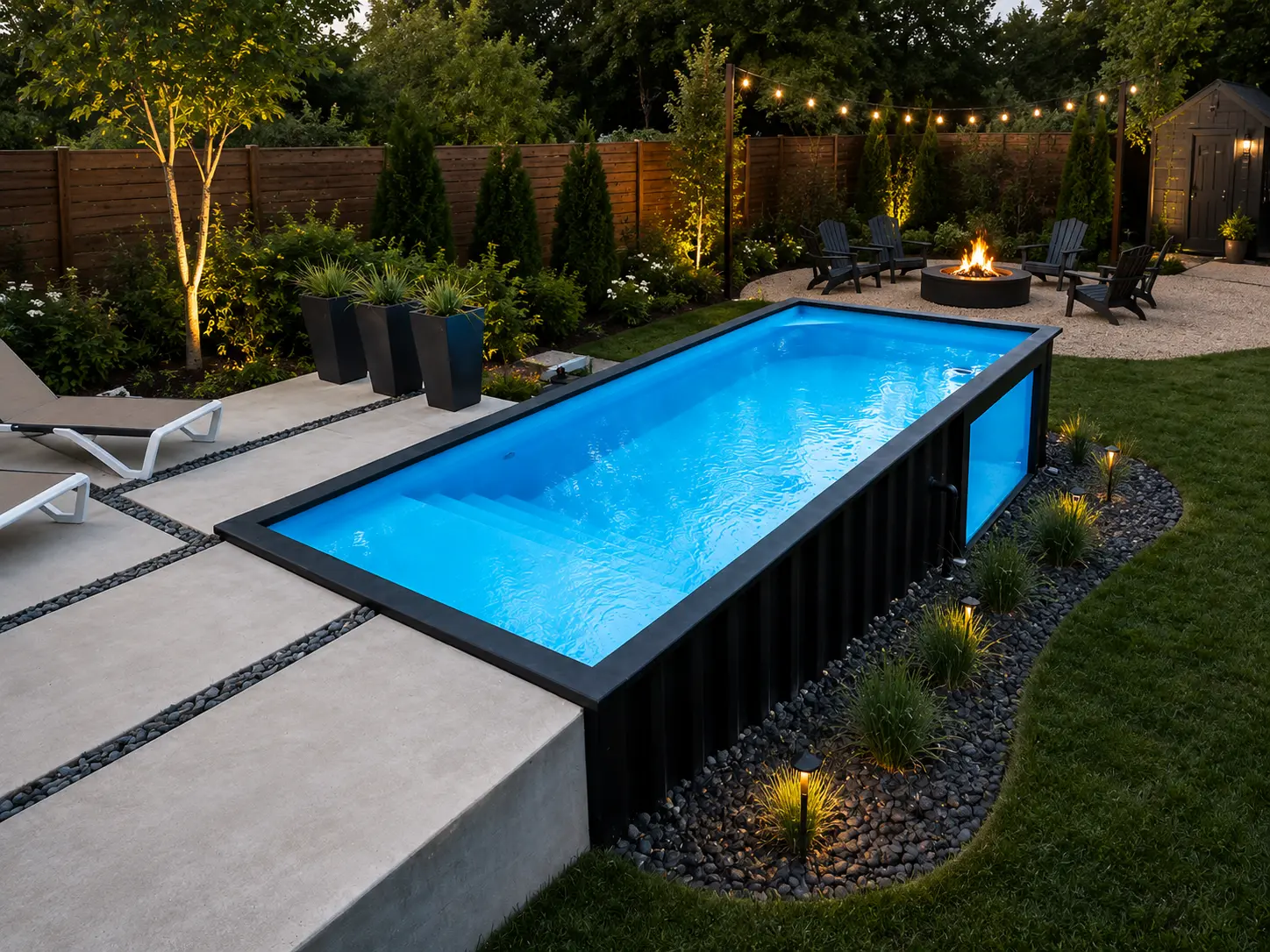
How they're built: the basic difference
Container pool
- Steel shipping container(s) cut, reinforced, insulated, and waterproofed
- Largely fabricated off-site, then craned into place
- Minimal excavation—often just a gravel or slab pad
- Fixed dimensions based on container size (or combined units)
Gunite/concrete pool
- Excavated on-site, rebar cage built, gunite sprayed and cured
- Fully custom shape, depth, and features (tanning ledges, spas, infinity edges)
- Plaster, pebble, or tile finish applied after curing
- Weeks of heavy equipment and crew on your property
Fiberglass pool
- Pre-molded shell delivered and craned into an excavated hole
- Faster than gunite, but still requires significant excavation
- Limited to manufacturer's shape and size catalog
At a glance
Detailed comparison
| Aspect | Container pool | Gunite/concrete | Winner |
|---|---|---|---|
| Starting cost | $35K–$75K | $65K–$120K+ | Container |
| Install time | 2–6 weeks | 3–6 months | Container |
| Site disruption | Minimal, mostly off-site build | Extensive excavation & mess | Container |
| Small/tight yards | Excellent, crane-set | Difficult, needs equipment access | Container |
| Permitting | Simpler, sometimes modular rules | Full pool permit + engineering | Container |
| Shell material | Corten/marine-grade steel | Sprayed concrete (gunite) | Tie |
| Durability | 20–30+ years with coating care | 30–50+ years | Gunite |
| Relocatable | Yes, in some cases | No, permanent | Container |
| Custom shapes | Limited (rectangular/linear) | Fully custom, freeform | Gunite |
| Depth/size limits | Limited by container dimensions | Virtually unlimited | Gunite |
| Resale value | Growing, still niche | Well-established, expected | Gunite |
| Maintenance | Similar chemical upkeep, coating checks | Standard pool maintenance | Tie |
| Aesthetics | Modern, industrial-chic | Traditional, blends w/ landscape | Tie |
Cost breakdown
Container pools typically start around $35K–$75K for a single or double container build, while gunite pools often run $65K–$120K+ once you factor in excavation, engineering, and finishes. See our full container pool cost breakdown for a size-by-size look at Texas pricing.
Install time & site disruption
A container pool can go from delivery to swim-ready in 2–6 weeks, since most of the fabrication happens off-site. Gunite pools take 3–6 months from excavation through curing, plaster, and start-up—plus weeks of trucks, dust, and heavy equipment on your property. For homeowners who need a fast turnaround or have a tight, hard-to-access lot, this is often the deciding factor.
Footprint & small yards
Because container pools are craned into place as a finished (or near-finished) unit, they work exceptionally well on narrow urban lots, sloped yards, and properties with limited excavation access. Gunite pools need room for equipment, spoil removal, and formwork, which can be a dealbreaker on small or oddly-shaped lots.
Permitting
Permitting requirements vary by city and county, but container pools can sometimes move through review faster since less structural excavation and drainage engineering is involved. That said, every Texas municipality treats in-ground water features similarly for safety code (fencing, barriers, electrical)—don't assume a container pool skips permitting altogether.
Durability: Corten & marine-grade steel
Quality container pool builders use Corten steel or marine-grade steel, treat the shell with rust-inhibiting coatings, and often add spray-foam insulation and a waterproof liner system. With proper coating maintenance, these shells are built to last 20–30+ years in the Texas climate. Gunite shells, when properly engineered and reinforced, can last 30–50 years or more, which is why some buyers still lean toward concrete for a "forever" pool.
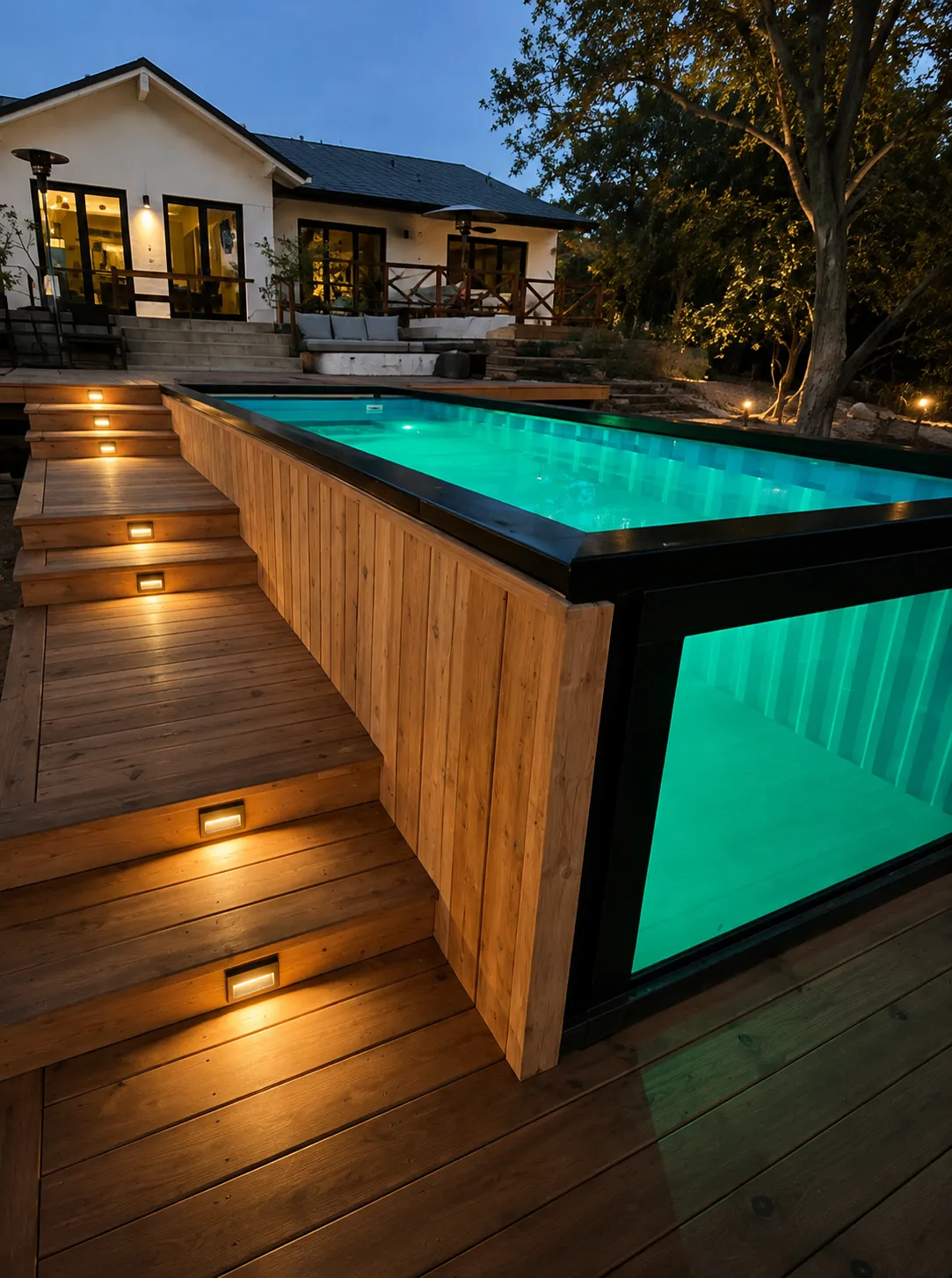
Relocatability
One unique advantage: some container pools can be uninstalled and relocated if you move or redesign your yard—something virtually impossible with a poured gunite shell. This isn't guaranteed on every build (it depends on plumbing, decking, and how it was set), but it's an option gunite simply doesn't offer.
Resale value
Gunite pools remain the market expectation in most Texas neighborhoods, and appraisers and buyers are very familiar with them. Container pools are gaining traction and can be a real selling point for design-forward buyers, but they're still a newer category—resale premium data is less established than for traditional pools.
Maintenance
Water chemistry, filtration, and cleaning are largely similar across all pool types. The difference is shell-specific upkeep: container pools benefit from periodic coating and seal inspections, while gunite pools need attention to plaster/pebble finish and occasional resurfacing. See our container pool maintenance guide for a full seasonal checklist.
Aesthetics
Container pools bring a modern, industrial-chic look with clean lines that pair well with contemporary homes. Gunite pools blend more naturally into varied landscape styles and can be finished with tile, pebble, or custom coping to match almost any aesthetic.
Depth & size limits
A single 8x40 ft container gives you a lap-style pool roughly 8 ft wide and 40 ft long; combining containers can widen or extend that footprint, but you're always working within steel dimensions. Gunite has no such constraint—if you want a deep-end diving pool, a freeform lagoon shape, or an attached spa with a raised wall, concrete is the only way to get there.
Where gunite still wins
- Fully custom shapes, curves, and freeform designs
- Diving depths and large, resort-style layouts
- Integrated features like tanning ledges, spillover spas, and infinity edges
- Maximum long-term resale familiarity in traditional neighborhoods
- Ultimate structural lifespan when properly engineered
Honest advice
When a container pool is NOT the right choice
Consider gunite or fiberglass instead if…
- You want a large, freeform, or resort-style pool design
- You need diving depth or want an attached raised spa
- Your lot has easy excavation access and cost isn't the top priority
- You're in a neighborhood where traditional pools dominate and resale familiarity matters most
- You want the longest possible structural lifespan with no coating maintenance
- You need a shape or size larger than standard container dimensions allow
A container pool is a great fit if…
- You have a small, narrow, or hard-to-access yard
- You want to minimize construction time and disruption
- You're drawn to a modern, industrial aesthetic
- Budget efficiency and speed matter more than total customization
- You may want the option to relocate down the road
FAQ
Common questions
Is a container pool cheaper than a gunite pool?
Usually yes for smaller pools—container pools often start lower and finish in weeks, not months, saving on labor and site costs.
Are container pools as durable as concrete pools?
Corten and marine-grade steel shells are engineered for decades of use, but gunite still edges out on ultimate lifespan and structural flexibility.
Can a container pool be any size or shape?
No. Container pools are limited to the dimensions of shipping containers (often 8x20, 8x40 ft, or combined units). Gunite can be poured into virtually any shape or depth.
Do container pools hurt resale value?
Not necessarily, but they're still a newer category in Texas. Traditional gunite pools remain the market expectation in many neighborhoods.
When should I choose gunite instead?
If you want a large freeform pool, a diving-depth pool, an infinity edge, or maximum resale predictability, gunite is usually the better fit.
Not sure which pool type fits your yard?
We'll walk your property, talk through container vs. traditional options, and give you an honest recommendation. No pressure.
Text (817) 372-8105 — we usually reply the same day.