
Founder guide
Shipping container pool pros and cons: an honest guide
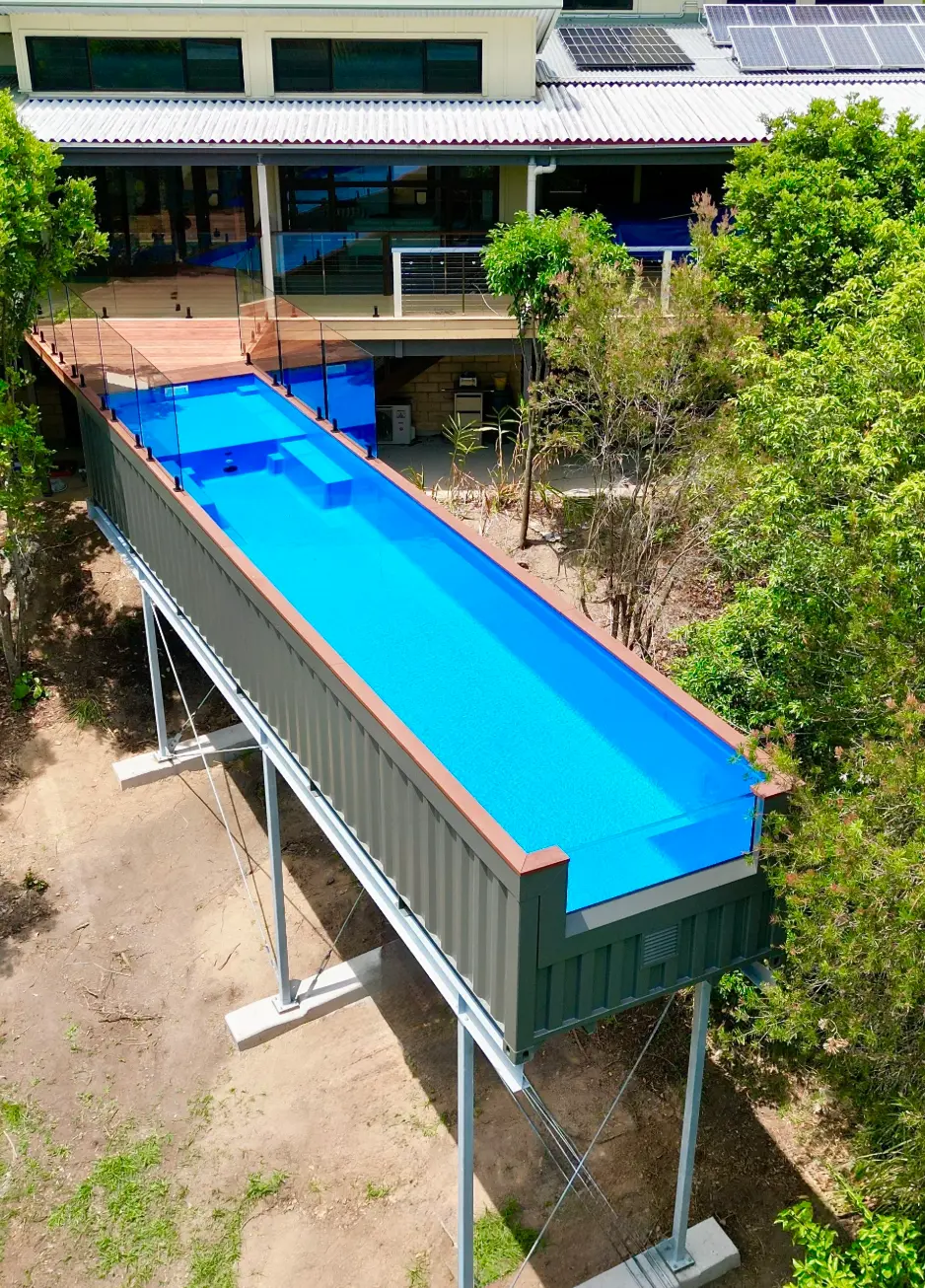
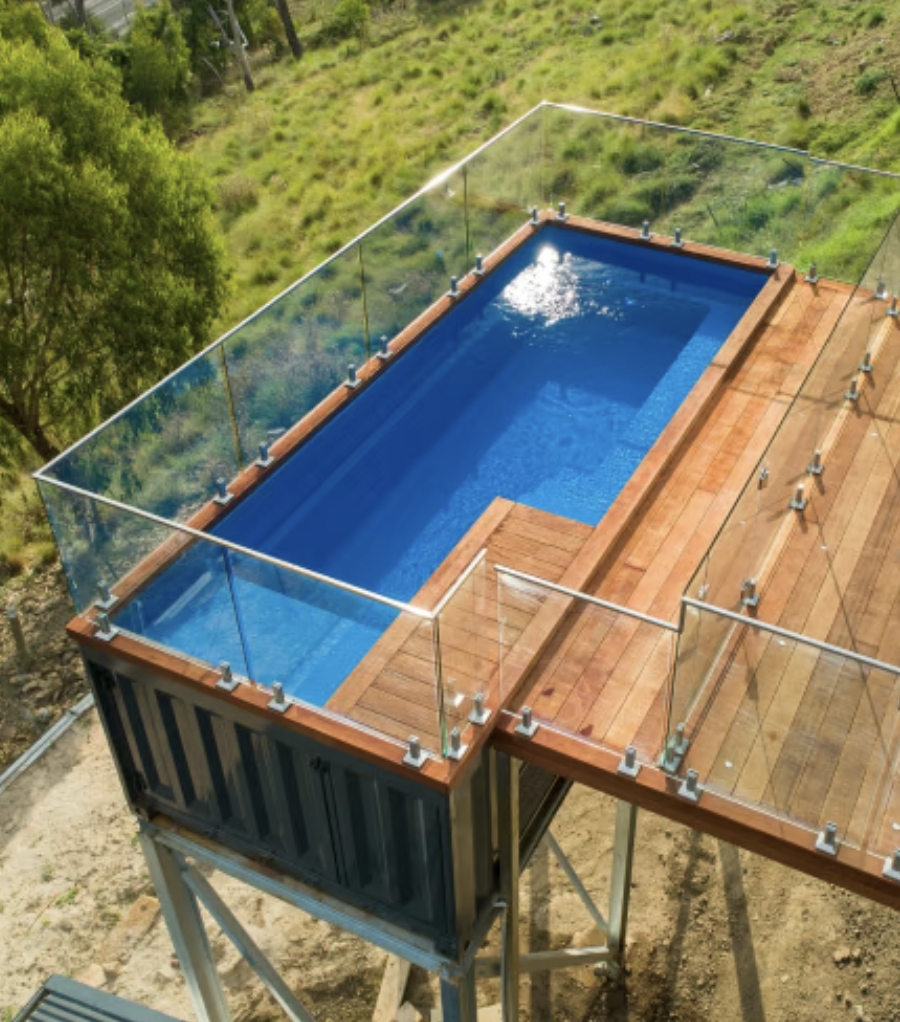
I sell shipping container pools, so you should read anything I write about them with one eyebrow raised. Here's my promise for this page: I'm going to give you the cons with the same energy as the pros. A container pool is a great answer for some yards and a bad one for others. If it's wrong for yours, I'd rather you find out here than after a crane is booked.
Some context on me. I spent about 20 years building software before starting The Container Pool Company. My grandfather started a pool company in Granbury, Texas more than 40 years ago and still runs it, and my dad spent nearly a decade building homes around Dallas–Fort Worth.
What a container pool actually is
It isn't an old box filled with water. We start with a new one-trip shipping container, cut it to height, and rebuild it as a pool: steel plate floor on a welded steel tube frame, a steel cap around the top, a seamless polyurea interior, plumbing, swim jets, an underwater LED light and an equipment bay hidden behind an in-pool bench at one end. Our fabrication partner in Georgetown, Texas builds it, fills it with water and tests it, then it's trucked to your property and set by crane.
We build six sizes: 8x20, 8x40 and 8x60, plus 16x20, 16x40 and 16x60 (two containers joined side by side).
The pros
1. It's built in a shop, not in your backyard
Fabrication happens indoors with welders and coaters who do this every day. While that's happening, your yard gets prepped. A gunite pool, by contrast, is built entirely on site. One pool manufacturer estimates concrete pools average 2–5 months. Your yard still sees a pad, a crane day and finish work, but far less of it.
2. It's tested before it shows up
Every one of our pools is water-tested at the shop before it ships. You know the shell and plumbing hold water before it ever reaches your property.
3. It fits lots that a dug pool can't
An 8-foot-wide pool slides into side yards, narrow infill lots and courtyards. On a slope, the pool can sit on concrete piers and stay level instead of carving into the hill (more on the cost of that below).
4. It can sit above ground, and be moved later
Most pools are permanent holes in the ground. An above-ground container pool sits on a level slab or piers and can be lifted out by crane and relocated if you move or redesign the yard. Industry sources list relocation as one of the category's genuine advantages. In-ground container installs are much harder to move.
5. Great for laps
A 40- or 60-foot lane, 8 feet wide, is a real lap pool, and swim jets come standard in our base configuration.
6. It looks like architecture
Clean lines, steel edges, an optional deck flush with the rim. On a modern house it looks deliberate rather than dropped in. That's a matter of taste, which brings us to the cons.
7. Pricing is straightforward
Because the pool is a defined product built in a shop, that part of the project is predictable. The site work is the variable, and we quote it line by line. A basic 8x20 on a flat lot typically lands between $50,000 and $100,000 all-in.
The cons
1. It's probably not cheaper than you hoped
This is the big one. Headlines say "$25,000 container pool." A finished, permitted, installed pool is a different animal. On a flat North Texas lot, our basic 8x20 installs typically run $50,000–$100,000 all-in. Sloped lots and elevated decks start at $100,000+. River Pools, a fiberglass manufacturer that writes about container pools, makes the same point: once delivery, crane, decking, fencing, electrical, plumbing and permits are added, costs can rival a traditional in-ground pool. Full breakdown: container pool cost in Texas.
2. Rectangles only, 8 or 16 feet wide
No curves, no freeform lagoon, no wraparound tanning ledge, no diving board. An 8-wide pool is great for laps and lounging but feels narrow for a big group floating around. If you entertain a crowd, look at a 16-wide pool or consider gunite.
3. Steel needs its coatings looked after
Steel rusts when it's exposed. The interior is sealed with polyurea and the exterior is coated, and as long as those coatings stay intact, the steel is protected. Every honest source on container pools flags corrosion as the main long-term risk, and some caution that salt systems can accelerate it. Practically, that means inspecting the coatings every season and touching up chips promptly. Talk to us about sanitizer choice during design.
4. Water temperature swings more above ground
A pool surrounded by soil gets some temperature buffering from the earth. An above-ground steel pool doesn't. Expect warmer water in a Texas August and cooler water in shoulder season. Heating is an add-on (our base configuration doesn't include a heater), and insulation can be added to the build.
5. It needs a crane, which means it needs access
The pool goes in as one piece, usually over the house or fence. Most lots work. Some don't, at least not without a bigger crane. Overhead power lines matter: federal safety rules generally keep cranes 20 feet from lines unless the utility de-energizes them. We check access before you spend money on design.
6. Barrier and code rules still apply
"Above ground" doesn't mean "no permit." Most Texas cities permit a container pool like any other pool. Under the residential code, a pool wall can act as the barrier if it's at least 48 inches tall and the ladder is removable or lockable. Once you add a deck at the rim, you'll usually need a separate fence.
7. Resale is less predictable
Texas buyers and appraisers know gunite. Container pools are newer, so some buyers will love yours and others won't care. If you're building mostly for resale, that's a real consideration.
8. The category is young, and so are many builders (including us)
Container pools haven't been around as long as concrete or fiberglass, and many companies selling them are new. Ask any builder for written warranty terms, who actually fabricates the pool, whether it's water-tested before shipping, and who installs it.
Who a container pool is right for
- Narrow, small or awkward lots where excavation is impractical
- Sloped lots where a level, raised pool with a deck makes more sense than digging in, and the budget can absorb the piers and decking
- Lap swimmers who want a real lane
- Owners who like a modern, architectural look
- People who might move and want the option to take the pool with them
- Builders and short-term rental owners who want a defined product, delivered on schedule
Who should probably buy something else
- You want curves, a beach entry, diving depth or a big party pool → gunite
- You want the cheapest possible pool → an above-ground vinyl kit
- You have a flat, open lot and want a classic in-ground look → get fiberglass and gunite quotes too
- You won't commit to basic coating checks → a container pool will punish neglect
There's a full three-way comparison in container pool vs fiberglass vs gunite.
The bottom line
A shipping container pool isn't a hack for getting a cheap pool. It's a well-built, shop-made product that works best on lots and for owners that traditional pools serve poorly. If that sounds like you, send us your yard. If it doesn't, I'll tell you.
FAQ
Do shipping container pools rust?
Steel can rust wherever its coating is damaged. A sealed polyurea interior and coated exterior protect it, which is why owners should inspect coatings each season and touch up chips quickly.
Are container pools worth it?
They're worth it when your lot, your swimming style or your design goals favor a rectangular, shop-built pool, or when you want the option to move it. They're not worth it if your main goal is the lowest price.
How long do container pools last?
It depends heavily on build quality and coating care. Published estimates vary widely. Pool Research cites 10–20+ years, and longer with good maintenance. We won't quote a lifespan for our own pools until they've been in the ground for real years.
Do container pools get too hot in Texas?
Above-ground pools track air temperature more than in-ground pools do, so summer water runs warmer. Shade, a cover and an above-ground placement out of afternoon sun all help.
Can you put a container pool in the ground?
Yes. Fully in-ground, partially recessed or above ground. In-ground costs more and moves the equipment to a separate pad outside the pool.
Do I need a fence around an above-ground container pool?
Often yes, especially if a deck gives access at the rim. Local code decides. Some above-ground setups can use the pool wall as the barrier if it's at least 48 inches tall and the ladder is removable or lockable.
Sources
- Pros and cons, cost rivaling in-ground pools, corrosion, temperature swings, relocation (updated Feb 2026): River Pools: Shipping Container Pools, The Essential Pros and Cons
- Lifespan estimates, salt and steel caution, inconsistent cost claims: Pool Research: Shipping Container Pools
- Concrete pool build time: River Pools: Common pool construction questions
- Crane 20-ft power line clearance: Mass.gov summary of OSHA 1926.1408
- Above-ground barrier rules (IRC AG106): Jaspector: IRC 2024 above-ground pool barriers
READY TO GET STARTED?
Send your project details. A real person replies within one business day.
Designs, pricing and timelines are preliminary until a written agreement.