
Founder guide
Can you put a container pool on a sloped yard?
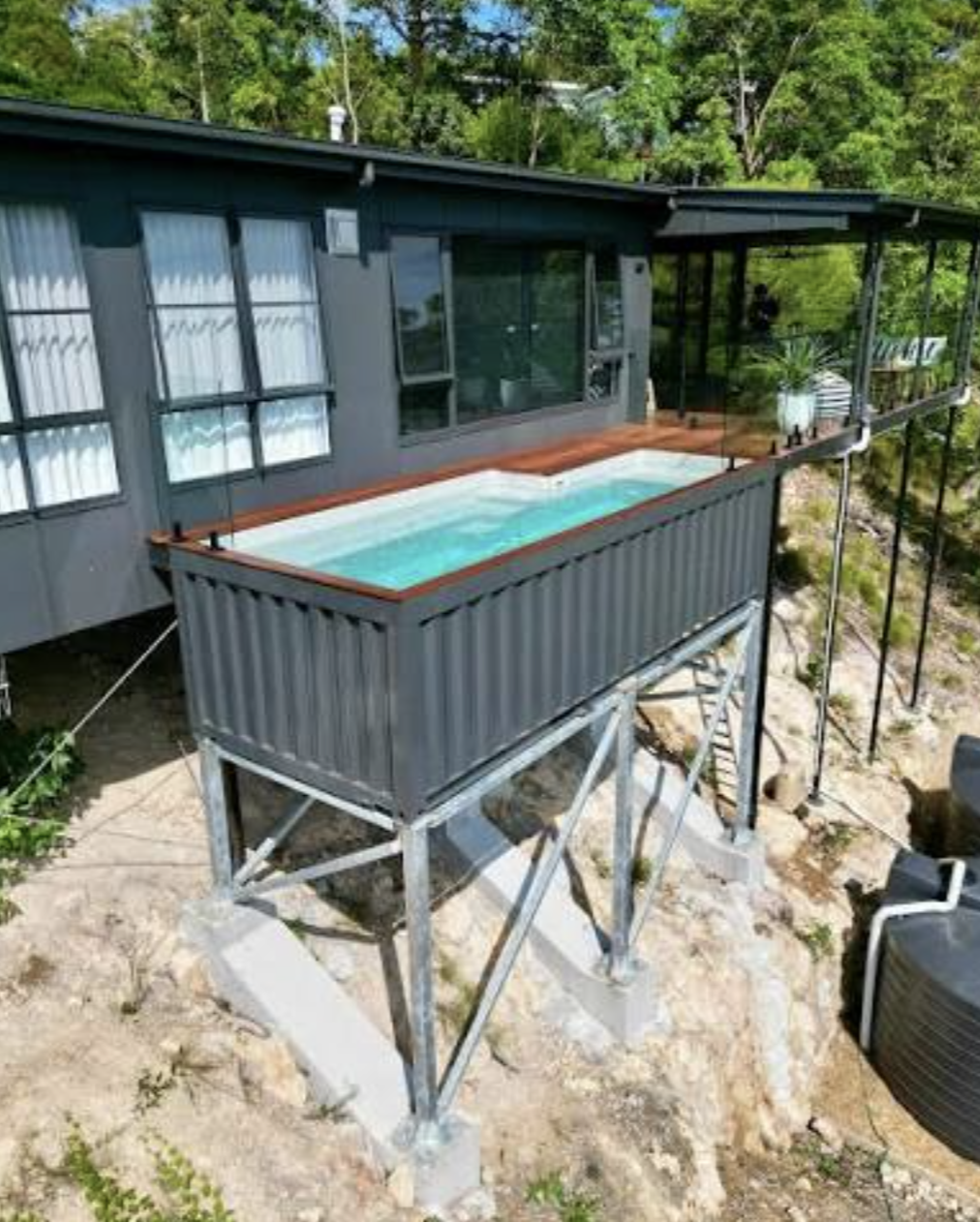
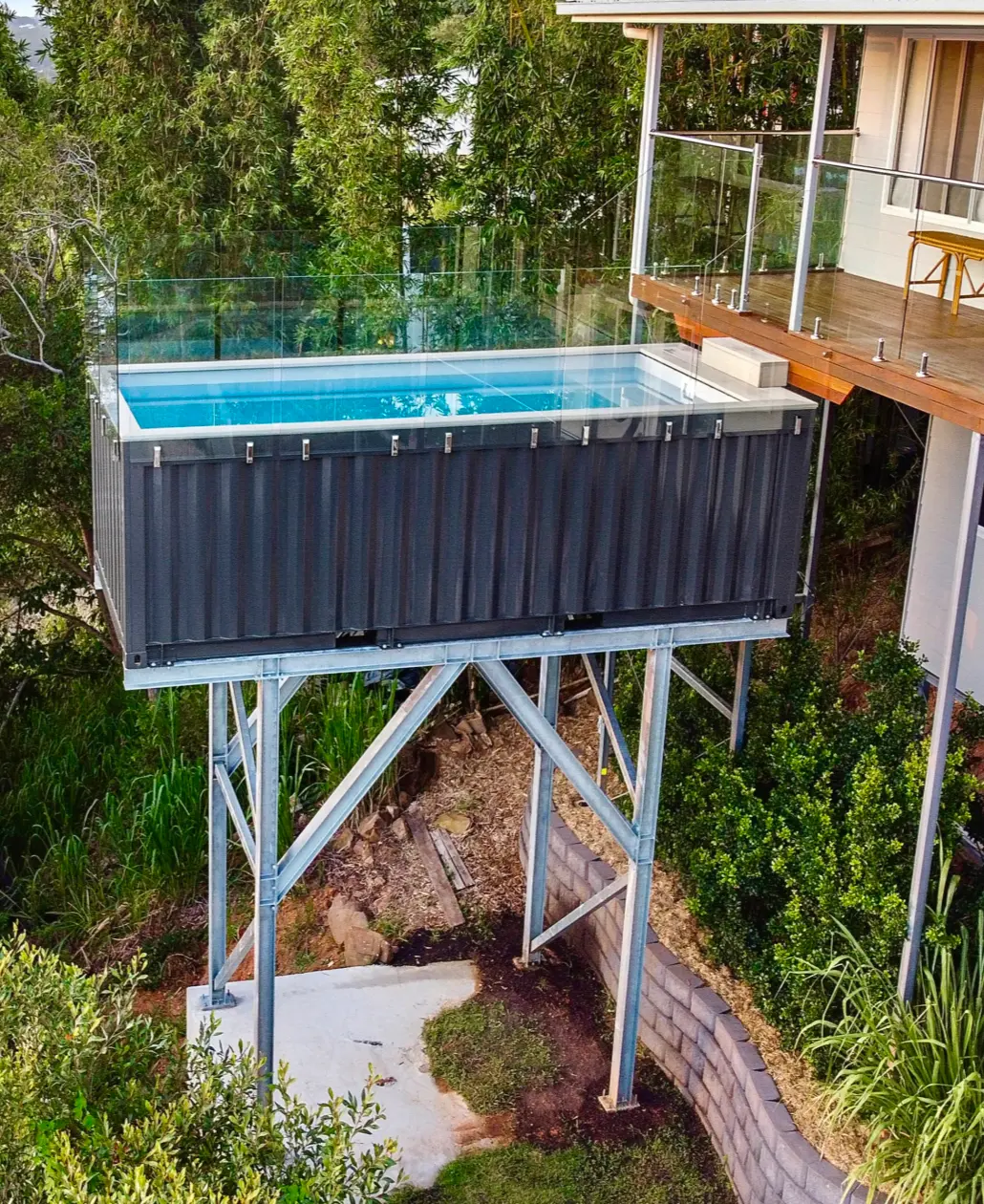
Yes. A sloped yard is one of the places a shipping container pool makes the most sense. But "it can be done" and "it's cheap" are different statements, and I want to be clear about both.
A container pool has one non-negotiable requirement: it has to sit perfectly level. Water doesn't care what your yard looks like. If one end of a 40-foot pool sits two inches low, you'll see it at the waterline. So the real question isn't whether it works on a slope. It's which way you'll make it level and what that costs.
I'm Tanson Bothe, founder of The Container Pool Company. We design and install container pools across Texas, and sloped lots (Hill Country, Lake Travis, the creek lots around DFW) come up constantly. This guide covers how we approach them and what they cost.
The three ways to level a pool on a slope
Option 1: Cut and level (set it on a slab)
We dig the high side down to make a flat pad, hold back the uphill soil with a retaining wall if needed, pour a level concrete slab, and set the pool on it.
- Best for: gentle slopes, a few feet of fall across the pool footprint
- Look: the pool sits at or near the uphill grade, often partially recessed, with the downhill side exposed
- Watch for: retaining walls, drainage and soil haul-off. National guides put retaining walls at about $10–$35 per square foot depending on material. Taller walls need more engineering, drainage and a stronger base.
Option 2: Raise it on piers (with a deck)
Instead of moving the hill, we leave it alone. The pool sits on concrete pillars with steel piers, usually six, each a different height, so the pool is dead level while the ground falls away beneath it. Then we build an elevated deck around it.
- Best for: steeper slopes, lake and view lots, yards where digging would mean a big wall
- Look: a floating pool with a deck at rim height and the view out front. This is the classic Hill Country and lake-lot setup.
- Watch for: the deck. Elevated decking is usually the biggest line item on these projects, often more than the piers. Pier foundations in North Texas clay commonly use helical or drilled piers, and a DFW foundation contractor puts helical piers at roughly $1,000–$3,000 each, depending on soil and depth.
- Bonus: an above-ground pool on piers can still be lifted out by crane and moved later.
Option 3: Set it into the hill (partial or full in-ground)
We excavate into the slope so the pool sits partly or fully below the uphill grade. It often needs retaining on the uphill side.
- Best for: owners who want the pool flush with an upper patio
- Look: flush on one side, maybe a dramatic exposed wall on the downhill side
- Watch for: excavation, rock (very common in the Hill Country), drainage, and the fact that on an in-ground build the equipment moves out of the pool to a separate pad, since the equipment bay doors at the end of the pool would be buried.
So what does a sloped install cost?
Here's the honest range:
- The pool itself doesn't change. The same base-configuration pool, custom-quoted, with freight quoted to your address. What changes is the site work.
- A basic install on a flat lot adds about $25,000, putting a simple 8x20 in the $50,000–$100,000 all-in range.
- Sloped lots are where projects climb. Between retaining or piers, an elevated deck, longer crane reach and extra engineering, sloped and elevated projects start at $100,000+.
Where you land depends on three things:
- How much fall there is across the pool footprint
- How much deck you want around a raised pool
- What's under the surface: clay, rock or fill
That's why we do a design consultation before anyone gives you a "real" number. I'd rather tell you a slope is expensive on a 30-minute call than surprise you in an estimate. Full line items are in what a container pool costs in Texas.
Things that matter more on a slope
Soil
Most of North Texas sits on expansive clay. The Blackland Prairie's Houston Black soil, which is the official Texas state soil, shrinks and swells as its moisture changes and cracks when it dries. That movement is why slabs and piers here are designed for the soil, not copied from a brochure. In the Hill Country it's the opposite problem: shallow rock that makes digging slow and piers sometimes easier.
Drainage
On a slope, water is always going somewhere. A pad or retaining wall that traps water against the uphill side is a problem, so drainage gets designed with the foundation, not after.
Crane access
Downhill sets are trickier. The crane may need to reach farther, and a crane on a hill needs a level, stable place to set up. Overhead power lines matter too, since safety rules generally keep cranes 20 feet away unless the utility de-energizes the line. We plan the pick during the site survey, before anything is built.
Safety barrier
On a raised pool, the pool wall can sometimes act as the code-required barrier, if it's at least 48 inches above grade and the ladder is removable or lockable. Once a deck gives access at rim height, you'll usually need a separate compliant fence or railing. Your city's code decides.
Call before you dig
Any digging, including pier holes, starts with a free Texas 811 utility locate. Texas 811 asks for at least two business days' notice, even on your own property.
Entry and equipment
On a raised pool, decide early how you'll get in: outside steps, a hook-on ladder from the deck, or steps in a cut-out corner. Also decide how you'll reach the equipment doors at the end of the pool. Plan deck heights around both.
Which sizes work best on slopes
- 8x20: the easiest to level and the cheapest to support; good for a plunge-and-lounge on a small hillside
- 8x40: a long lane that follows a contour line nicely; the slope is often gentler along the contour than across it
- 16-wide models: doable, but more piers, more deck and an oversize delivery
A tip: orient the long side of the pool along the contour (across the slope, not down it). You'll fight much less grade.
Is a sloped yard a good reason to choose a container pool?
Often, yes. With gunite or fiberglass on a slope, you're excavating and retaining no matter what. With a container you have a third option, piers and a deck, that leaves the hill alone. For lake lots and view lots it can produce something a dug pool can't: a level pool floating above the view. Just budget for the deck. Decking and outdoor living options are on our outdoor living page.
If you send us photos of your slope (shoot from the house, from the far end of the yard and from the side) along with a survey if you have one, we can tell you which of the three options fits and roughly what it'll cost.
FAQ
Can you put a container pool on a hill?
Yes. It can be leveled on a cut-and-filled slab, raised on concrete piers with an elevated deck, or set partly or fully into the hill. Each has different costs and looks.
How much more does a container pool on a slope cost?
The pool price stays the same. Site work is what changes. A basic flat-lot 8x20 typically runs $50,000–$100,000 all-in, while sloped projects with piers or retaining walls and elevated decking start at $100,000+.
Do I need a retaining wall?
If you cut the slope down to make a flat pad, usually yes. If you raise the pool on piers instead, often no, but you'll be building a deck.
Can a raised container pool be moved later?
An above-ground pool on a slab or piers can be lifted out by crane and relocated. In-ground installs are much harder to move.
Does a raised pool need a fence?
It depends on your local code and design. The pool wall may serve as the barrier if it's at least 48 inches above grade with a removable or lockable ladder. Decks that reach the rim usually require a separate fence.
Will expansive clay crack the pad under my pool?
Clay movement is real in North Texas, which is why slabs and piers are designed for your specific soil and drainage, not a generic spec.
Sources
- Retaining wall cost per square foot: Inch Calculator: Cost to Build a Retaining Wall
- Helical pier cost and use in DFW soils: HD Foundation Repair: Helical Piers DFW
- Houston Black clay shrink-swell (Texas state soil): Texas Water Development Board: Texas State Soil
- Crane power-line clearance: Mass.gov summary of OSHA's 20-ft rule
- Above-ground pool barrier rules: Jaspector: IRC 2024 AG106
- Texas 811 notice period: Texas 811: Homeowners
READY TO GET STARTED?
Send your project details. A real person replies within one business day.
Designs, pricing and timelines are preliminary until a written agreement.